
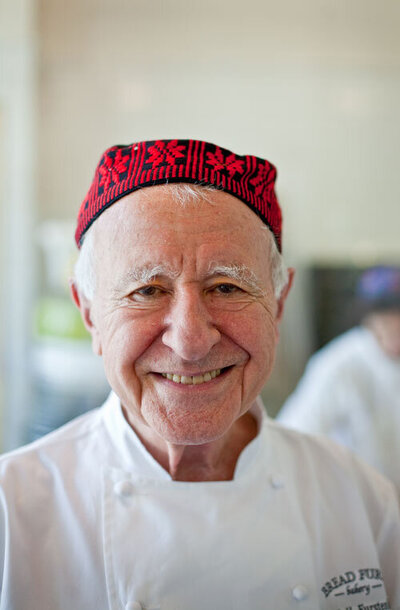
Joyce Goldstein’s (Surprise) 90th Birthday Party
July 31, 2025
Last week I flew to San Francisco to celebrate the 90th birthday of my friend Joyce Goldstein, one of the giants of American food. On the plane I found myself thinking yet again about the moment food began to matter more deeply to us – as a country and to me.
I have written about that before, and probably will do so again.
In 1984, Joyce, having been the opening chef of the Chez Panisse Café, opened her own San Francisco restaurant, Square One, the first U.S. restaurant to make and serve Mediterranean food.
In little time, her restaurant became a sensation and Joyce won a James Beard award. She was offering foods that were unknown in America at the time — meze (a word that was unfamiliar then), stews, braises, risotto, and sauces, spreads, and dressings like chermoula and skordalia. Square One also featured lamb, a meat far less popular than beef, and introduced fried kasseri cheese and bitter greens, not then congenial to the American palate.
I, on the other hand, was cooking only in my Washington home at that time as I commuted between Washington and Reading, Pennsylvania where I was the manager of the Reading Tube Corporation, a copper pipe manufacturer. It was one of the best jobs of my life. I loved the action, the noise, the anger, the drama of the plant, the quarrelling of the men and their foremen. I loved it all.
I left Reading Tube a year later, and after a very brief career at the Washington Post, became a bread baker. It was through my new career that I met Joyce. In 1992, both of us were sent to Rome by Oldways, an organization created to popularize the Mediterranean Diet. Of course, Joyce belonged on that trip; I, however, did not. I was included to make focaccia at a restaurant in Rome. That was ridiculous. Focaccia is not Roman; it is Italian; and many bakers would have been more qualified than I was to make it there.
It was in Rome that we became friends. We sat one evening on a sofa in the lobby of our hotel, smoking cigars and getting acquainted. The following day after our program, Joyce, who spoke Italian, went with me to look in pharmacies for a lipstick holder my mother had requested.
It was a hilarious walk. We got sillier and sillier as the proprietors of the little drugstores shook their heads and their hands with little gestures, so Italian, that they looked to us like characters from La Dolce Vita, the 1960 Italian movie.
I saw her on subsequent trips to San Francisco, and even more frequently when I began to commute once each month from Washington. I had been selected in 1995 as the baking instructor at the new campus of the Culinary Institute of America. I always stopped in San Francisco to have lunch or dinner with Joyce, and we worked together on the extraordinary conferences the CIA held each autumn.
This was an important time in my life – and in Joyce’s – and in the life of the CIA. Before 1995, The Culinary Institute of America was just a castle on the bluff overlooking the Hudson River at Hyde Park, New York. Just as it was hidden there, it hid from the culinary world that was slowly evolving. The CIA before 1995 focused its classes entirely on French food, and not only hid from other cuisines but also denied that there were other cuisines worth noticing.
When Greystone, west coast branch, opened in 1995, its programs were overseen by Greg Drescher, a food-focused traveler who had a far more expansive view of food. He guided the new CIA away from European foods and toward the foods of Latin America and Asia – at that time called by most people “ethnic foods”. He brought in teachers who knew far more than French food and even novices like me. He wanted me because I knew a little about non-European breads; and he wanted Joyce because she was a scholar.
In 1996, I made a special trip to San Francisco to bake bread for a farewell party celebrating the remarkable run of Joyce’s restaurant, Square One. Joyce was then only 61 years old, and certainly not ready to retire.
Retire indeed! She increased her travel and her consultation to start-up restaurants and to existing ones, from the Levy restaurant group to coming to Washington to help me open The BreadLine, my new restaurant and bakery at the time, just a block from the White House.
It was impossible to contain Joyce. She traveled all the time, and she wrote nine more books, adding to the 21 she had already published.
She was never without ideas, and exhausted even her publisher. And after that she wrote for the University of California Press a history of California Cuisine.
Preparations for her 90th birthday celebration began as soon as I arrived from the San Francisco airport. Dave and Kate, friends of mine and Joyce’s, and both passionate food people, were decorating their house where the party would take place.
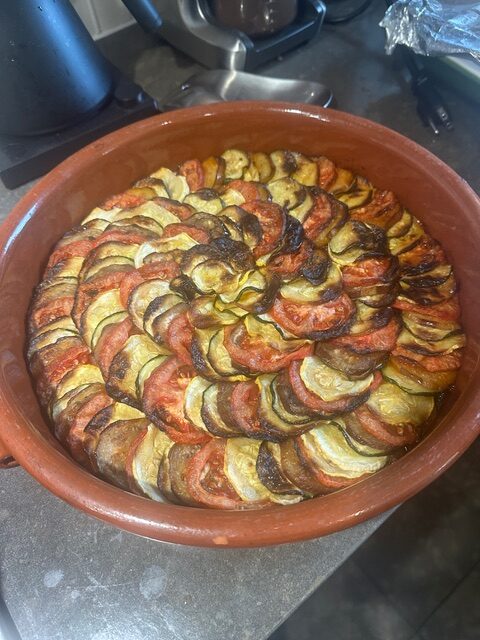
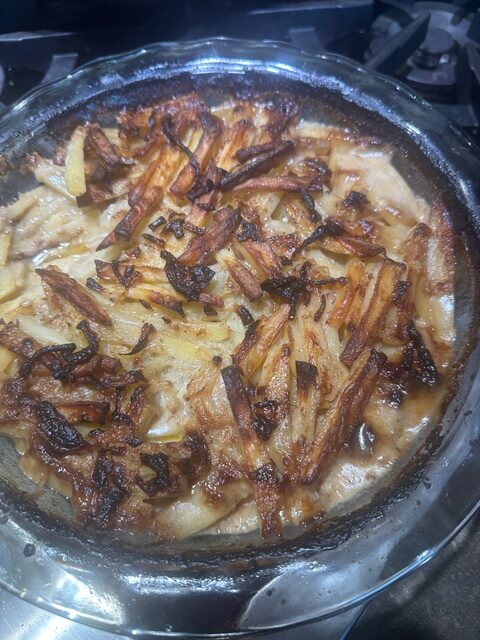
Early on her birthday, the other guest cooks began to arrive. We had just begun our preparation when Stefan Terje – a Swedish chef who once ran two Italian restaurants in San Francisco – walked in carrying two large dishes: one of ratatouille and the other of Jansen’s Temptation, a classic Swedish combination of potatoes, cream and anchovies. I’ve always loved that dish – my father was a Swede.
Others came too. Tom Worthington, who created and operates the Monterey Fish Company on a pier not too far from the Ferry Plaza Market, arrived with fish and clams and oysters for an appetizer he was planning.
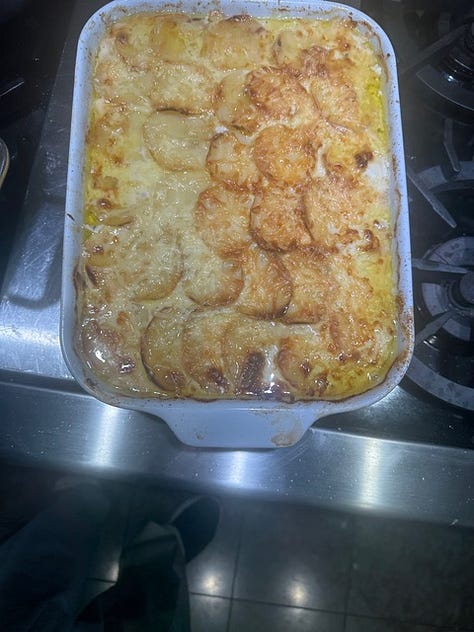
In an hour or so we were ready, scalloped potatoes bubbling in the oven, a tied-up lamb roast resting on top of the stove, Stefan cooking an enormous pan of enormous morels, Tom spreading out the preparation of shells and seaweed for his appetizer.
David McElroy, our host, left to fetch Joyce for our surprise. Then he and Joyce entered, descended the stairs to where the rest of us had gathered on two sides of the room for our surprise.

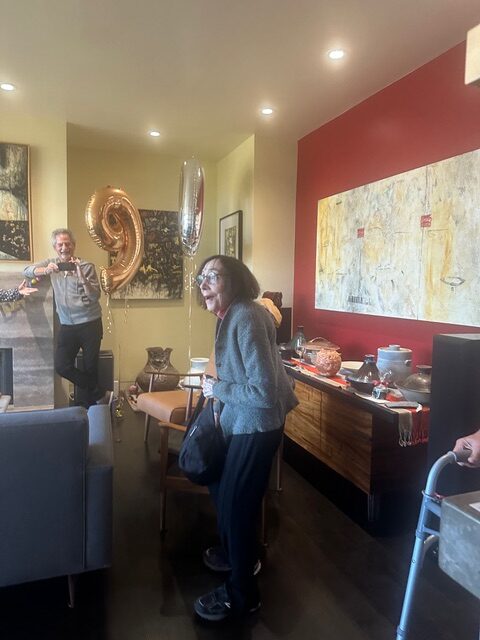
We ate and drank for the next four hours, but not because we were slow. We spent those hours toasting Joyce with eight bottles of wine and talking with her. Certainly, we talked about her and why we love her, but perhaps even more important, we talked about what she has contributed to the food of our country.
Goldstein is so well known in the culinary community that chefs all over the country refer to her simply as “Joyce” just as we used to speak of “Julia.” Few people in our Washington world achieve such distinction. Indeed, I know of no one in our legal/journalistic/political city other than Barney Frank and Cokie Roberts who are known by their first names alone.
But Joyce is one.
I must admit that I will never see her as a Californian. She talks too fast to be a Californian, and after all these years, still with a New York accent. She is opinionated, salty, articulate, argumentative, restless, impatient – she is Brooklyn amazingly untouched by a California style.
She could have been a great lawyer or politician or journalist, but she didn’t have to be. Because her father adored her. “He was a feminist,” says, “but he didn’t know it. He gave me the courage to do what I wanted.”
I’ll always remember a conversation I had with Joyce years ago when I subtly suggested that she slow down. She looked at me queerly and said, “I’m a shark. If I slow down, I die.”
Certainly, I, now 87 years old, can relate.