
Eating at the Furstenbergs’ in the Old Days
February 18, 2026
I went to Philadelphia last weekend for a memorial service. I stayed there one night in order to have dinner with family. My sister, Ellen who lives there selected a restaurant that was out somewhere in the suburbs. I don’t know exactly where it was.
The restaurant was nearly empty, and it stayed empty throughout our meal. It is too new to have been discovered so far. I think that delighted Ellie. She loves to discover hole-in-the-wall restaurants that no one else knows about. So do my brothers.
We all love the discovery because we all love to eat.
I have wondered much of my life why I am so obsessed with food. That happened many decades before I became a baker. I don’t mind the obsession; in fact, I like it. But still I wonder how it happened. Afterall, not everyone is as obsessed with food as my siblings and I are.
When World War II ended in 1945, my family returned to the house my parents had bought before the War began. Not too long after that, my parents learned that my mother was expecting twins. So we moved into a much larger house, one built in the eighteenth or early-nineteenth century, a sprawling two-story structure, long and narrow.
The house was built on the top of three hills. The walkway from the street that led up to the house was covered by huge English boxwoods that were said to be more than a hundred years old.
The floors of the house were made from pine. That too was amusing, especially when a dinner guest of my parents who was wearing high heels caught her heel in a knot in the floor and slowly sank into the basement below her.
We never stopped talking about that.
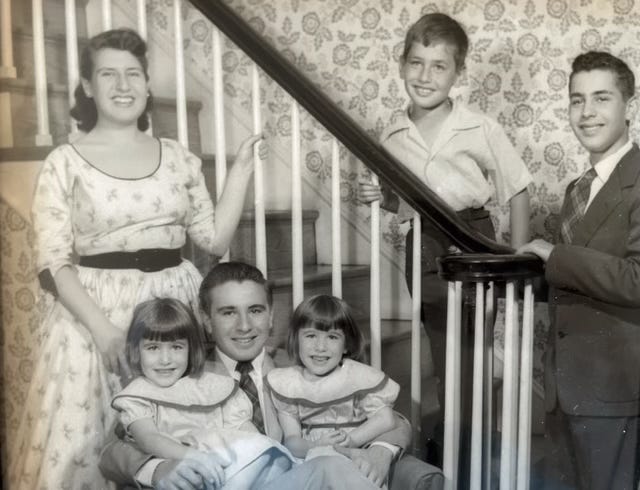
In the new house, my siblings and I were separated by gender, although not deliberately so, I think. Carla, the oldest of us, lived in a large room on one side of the house, with the twins, born that year, in a room next to hers. Our parents lived in the middle of the house, and the boys lived on the other side in two rooms.
We all came together twice a day, for breakfast and for dinner. Breakfast was disorderly, with family members arriving, often late, and leaving at different times for different schools.
But at dinner we’d all convene to eat in the dining room.
It could have been a peaceful time of reconciliation at the end of the day. Sometimes it was that, but more often it wasn’t so relaxing.
My father was a doctor, an allergist, who suffered from two sorts of allergy himself. One was the hospital at which he played major innovative roles but felt unappreciated. The other “allergy” was that he was a depressive who could not escape his somber moods.
Every day, my father returned from his office downtown or from the hospital promptly at 6 o’clock. He sat down in the same living room chair and read the Evening Sun paper. At 6:20 he rose for dinner – and we did too. We were always famished and did not want to wait an unnecessary minute to eat.
My father sat down at one end of the table, my mother at the other. My siblings and I sat on the two long sides of the table, always in the same places. We, the children, always had to gauge my father’s mood, even before we began to eat. If he was sour, we were relatively quiet. If he seemed relaxed, we were rampageous.
My mother, on the other hand, was always sunny. She always had topics of conversation – two or three. If my father was depressed, she was lively. If my father was in a good frame of mind, she was lively. She sensed my father’s moods and respected them, but she always kept the tableside conversation moving back to happy topics.
But what was most important about the dinners at our table was the food.
We passed food to each other, filling the clean plates in front of us from serving plates. I don’t recall any of us serving ourselves in unusual quantities. But although we didn’t serve ourselves like pigs, we ate like pigs – every night.
We used to teasingly blame our father for the speed of our eating. We said that he ate fast because of his medical internship where he might have been called away from his table at any moment. I think that was wrong; I think that he, like us, simply liked devouring his food as quickly as possible.
We couldn’t blame our mother for our avarice because she had been brought up by a mother who ate slowly and daintily. And her manners remained good.
In fact, I think, we ate fast because we were hungry, of course, but also because we were competitive with each other. And because we teenagers were perpetually hungry and wanted to fill ourselves as quickly as possible. I remember clearly that I ate staring at the serving plate, rushing my eating to be sure that those leftover servings still on the serving plate would be there when I finished my first helping.
I sat next to my brother Michael at our dinner table. While I finished my dinners lickety-split, Michael, ten years younger than I, ate deliberately, chewing slowly.
He was on a dangerous path. I watched him. He watched me:
“Mike, are you finished?”
“No.”
Then ten minutes later:
“Mike, is that all you want?”
“No, I’m eating.”
Then three minutes later:
“May I have a little taste?”
Michael put his arms around his plate and lowered his head toward it. He hunched up his shoulders until he had created a fort around and over his plate.
It was frustrating for me. I wanted his leftovers even before they were left over.
My mother was a very good cook. She had learned to cook during the War, when, for the first time, she did not have a cook and had to cook for our family. But she also learned that she liked it.
After the War, she continued to cook at home – and ingredients were plentiful again. We ate beef pot roast, pork roast, fried chicken, fried fish, fried scallops. We ate lots of potatoes because my father, a Swede, loved them. Sometimes we even ate a vegetable, although they weren’t very interestingly cooked.
When, after the War, food companies began to invent foods for our homes, my mother sometimes experimented the new “convenience foods.” Orange juice came from a cardboard can. Salad dressings came to us dehydrated in little envelopes. They were convenient, but also tasteless.
We relished our dinners, but I am not certain that we knew how good the food was that our mother cooked. I surely did not know how devoted we were to food compared to my friends at school who hardly noticed what they ate at lunchtime – tuna salad, egg salad, and peanut butter and jelly.
Some of my friends were recent immigrants; some of their parents had been in concentration camps before they arrived in Baltimore. We, on the other hand, had been in Baltimore forever, and had always been prosperous. So why did we, of all people, eat so ravenously and fearfully?
Our grandparents had not been refugees who arrived at Ellis Island, hungry. They had not been deprived of food, either. My sister Carla used to say it was because we were deprived in other ways, and made food a replacement for what we did not get.
Perhaps that is right. I’ll never know.
My mother spent the last 15 years of her life at an assisted living home in Baltimore. When I arrived to see her – even before kissing me hello – “Can we go up the hill for lunch?” She meant Woodbury Kitchen, a wonderful restaurant of Spike Gjerde.
And we would always do it.
I would bet that her car – a 1997 Honda Accord – still driven by my sentimental son, Francois – still has my mother’s food wrappings and smells of her leftovers.

Until I started dating my wife as a 20 year old, I did not know that “seconds’ even existed. We were served a plate of food and had to finish everything before being granted permission to leave the table. We may have had one restaurant meal a year. Fortunately, my mother was an excellent cook. We spent every minute of daylight outside with the kids on our block of row houses. There were so many kids on my block in the 50s and early 60s that I did not know any kids on adjacent blocks unless they were in my class in school. There was an unspoken agreement among the parents on the block that birthday parties were for siblings only, no friends. There was barely enough money for your own kid’s birthday present. There were no sleepovers because no one had space for guests. It was heaven on earth!
I am so happy to hear from you. As well as to hear your memory. I think it is time for us to see each other again. Do you have my email?
-Mark